The Flavor Dimension Your Taste Buds Were Never Taught to Find
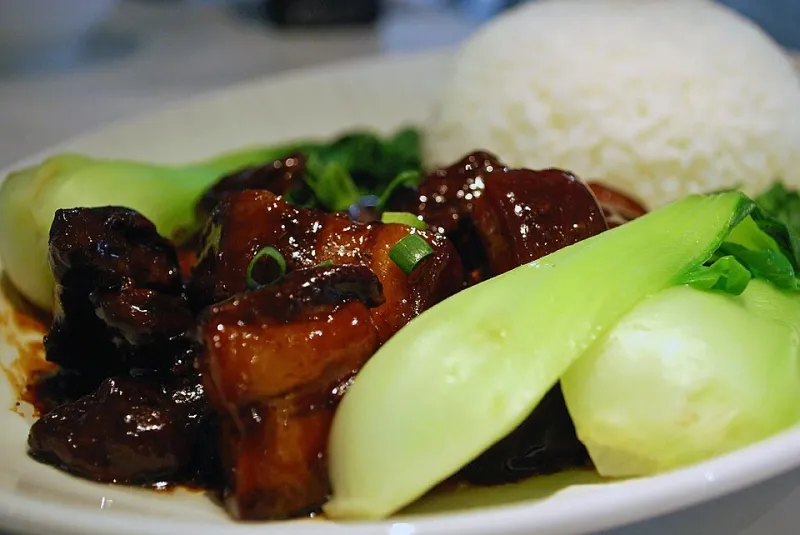
Photo: Alpha from Melbourne, Australia, CC BY-SA 2.0, via Wikimedia Commons
Ask most Americans to describe the five basic tastes and they'll get four right without hesitating: sweet, salty, sour, bitter. Maybe they'll throw in umami if they've been paying attention to food media over the last decade or so. But even that — even the growing American awareness of umami — only scratches the surface of what Shanghai cuisine is actually doing when it builds flavor.
Because in Shanghai's culinary vocabulary, there's a concept that doesn't translate cleanly into any of those categories. It's called 味 — pronounced wèi — and while the character literally just means "taste" or "flavor," the way it functions in Shanghai cooking describes something far more specific: a quality of savory depth, roundness, and resonance that makes a dish feel complete rather than merely seasoned.
This isn't just semantics. Understanding wèi changes how you cook, how you taste, and how you troubleshoot a dish that's technically correct but somehow feels flat.
The Four-Taste Framework and Its Blind Spots
Western culinary science has long organized flavor around four primary tastes, with umami added relatively recently after Japanese researcher Kikunae Ikeda identified glutamate as a distinct sensory category in 1908. Even so, American cooking education — from high school home economics to culinary school — tends to treat these categories as separate levers you pull independently.
You add salt to season. You add acid to brighten. You add sugar to balance. These are transactions.
Shanghai cooking doesn't think in transactions. It thinks in relationships. The goal isn't to hit the right notes on each individual flavor axis — it's to create a condition where all the elements are in conversation with each other, producing something that's more than the sum of its parts. That emergent quality — that sense of fullness and resonance — is what a Shanghai cook means when they say a dish has good wèi.
What Wèi Actually Feels Like
Here's a useful way to understand it through experience rather than description: think about the difference between a bowl of instant ramen and a bowl of properly made tonkotsu broth. Both are salty. Both have savory notes. But one of them coats your mouth, lingers, and makes you feel genuinely satisfied, while the other tastes sharp and then disappears.
That lingering, coating, deeply satisfying quality is wèi at work. It's not just glutamate — though glutamate contributes. It's the combination of glutamate with nucleotides (which is why pairing ingredients like dried mushrooms and pork creates more depth than either alone), plus fat, plus time, plus the specific chemical transformations that happen during slow cooking or fermentation.
In Shanghai cuisine, this is achieved through a toolkit that's been refined over centuries: Shaoxing rice wine for fermented depth, dark soy sauce for body and color, rock sugar for a particular kind of round sweetness that white sugar can't replicate, and slow braising times that allow proteins to break down and release their full flavor contribution into the surrounding liquid.
The Ingredients That Build It
Shanghai's pantry is essentially a wèi-construction kit. Let's break down a few of the key players:
Shaoxing wine isn't just a cooking wine — it's a fermented, aged product with its own complex flavor profile that adds background notes impossible to achieve any other way. When American recipes substitute dry sherry, they get close, but they lose some of the specific fermented depth that makes Shanghai braising liquid taste the way it does.
Doubanjiang — fermented broad bean paste — contributes salt and heat, but more importantly it contributes the funk and complexity that comes from extended fermentation. This is wèi in concentrated form.
Dried seafood — shrimp, scallops, fish — shows up in Shanghai cooking as a background ingredient rather than a star. A small amount dissolved into a broth or sauce can add a layer of oceanic savoriness that you can't identify but would absolutely notice if it were missing.
Rock sugar deserves special attention. It's less aggressively sweet than refined white sugar, and it contributes a mild caramel undertone and a glossy texture to sauces that granulated sugar simply doesn't produce. When you taste a perfectly lacquered piece of hong shao rou and wonder why it tastes so much richer than pork belly you've made at home, rock sugar is often part of the answer.
Why Western Cooking Education Misses This
American culinary training is heavily influenced by French classical technique, which has its own sophisticated flavor-building methodology — fond, reduction, stock-making — but frames it primarily through the lens of concentration and extraction. You build flavor by reducing, by caramelizing, by deglazing.
Shanghai flavor-building is more additive and layered. You're not just concentrating what's already there — you're introducing a succession of fermented, aged, and dried ingredients that each contribute their own distinct character, then allowing those characters to meld over time into something unified.
The result is a different kind of depth. French demi-glace is extraordinary, but it's a different kind of extraordinary than a properly made Shanghai braising liquid. Both are complex. They're complex in different directions.
American home cooks who encounter Shanghai food for the first time often describe it as tasting "deeper" or "richer" without being able to explain why. That's wèi. You can taste it even when you don't have a word for it.
How to Start Building It
You don't need to overhaul your pantry overnight. Start with these moves:
- Add Shaoxing wine to anything braised. Even a splash before adding liquid transforms the depth of a braise.
- Use dark soy sauce alongside light. Light soy sauce seasons. Dark soy sauce adds body and color. Use both.
- Try rock sugar in savory dishes. Swap it for granulated sugar in any Chinese recipe that calls for sweetness. The difference is noticeable.
- Keep dried mushrooms on hand. Rehydrated shiitakes and their soaking liquid are a wèi shortcut that costs almost nothing.
- Cook low and slow when a recipe allows. Time is itself a wèi ingredient — it's what lets everything knit together.
Once you start building for wèi rather than just seasoning for salt, you'll start tasting its absence in dishes you used to think were fine. That's not a bad thing. That's your palate expanding.
And that's exactly what Shanghai cooking has been doing to people for centuries.