The Pantry Audit That Will Immediately Make You a Better Cook

Most American home cooks have at least one bottle of soy sauce in the cabinet. A lot of them have had the same brand since they first moved out on their own. It works, right? It's salty, it's dark, it smells like Chinese food. Job done.
Except it's not done, and it's probably not working as well as you think. The pantry staples you buy on autopilot — the ones you grab without reading the label because they've always been there — are doing more damage to your cooking than almost any technique mistake you could make. And because the problem is invisible (bad soy sauce still tastes like something), most people never connect the dots.
Shanghai cooking is built on a small set of foundational condiments and sauces, each one carrying a specific flavor responsibility in the dish. When any one of them is low quality or wrong for the application, the whole thing collapses — not dramatically, but in that frustrating way where your food tastes almost right but never quite lands. Here's how to fix it.
Soy Sauce: You Probably Have the Wrong One for Everything
The biggest misconception about soy sauce is that there's one kind. There isn't. There are at least two you should be keeping on hand, and they are not interchangeable.
Light soy sauce (生抽, shēng chōu) is what Shanghai cooks use for seasoning during cooking and as a finishing sauce. It's saltier, thinner, and lighter in color than what most Americans think of as soy sauce. It's what goes into a stir-fry, a dipping sauce, a marinade. If you've only got one bottle in your pantry, this is the one it should be.
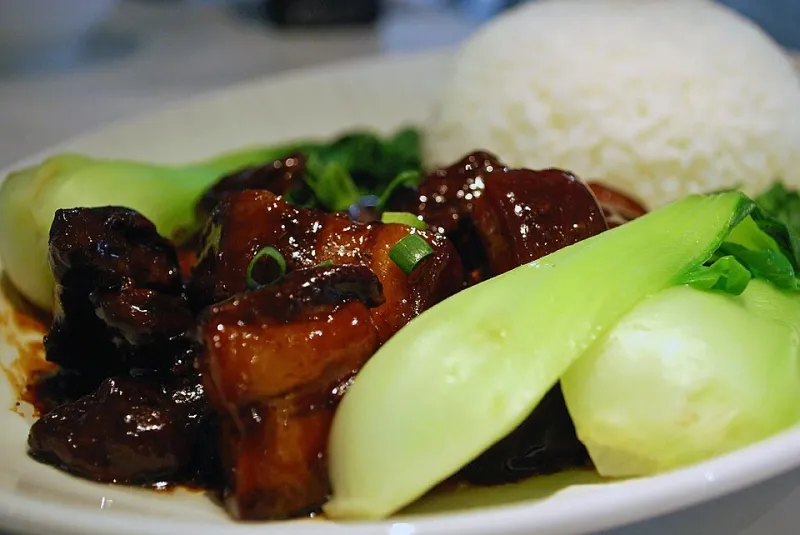
Dark soy sauce (老抽, lǎo chōu) is aged longer, thicker, slightly sweet, and used primarily for color and depth — not as a primary seasoning. A tablespoon of dark soy sauce is what gives red-braised pork its lacquered mahogany color. It's not meant to be used in large quantities.
The soy sauce most Americans grow up with — the big red-labeled bottle — is a kind of all-purpose compromise that isn't quite either one. It's fine for some applications, but it's muddier in flavor and often contains more additives than either of the traditional types. Look for light soy sauce from brands like Pearl River Bridge or Lee Kum Kee (their regular light soy, not the premium dark). You'll find both at any Asian grocery store and increasingly at Whole Foods or H-E-B. The price difference is minimal. The flavor difference is not.
Rice Vinegar: The Invisible Backbone Nobody Talks About
Rice vinegar does quiet, essential work in Shanghai cooking. It brightens braised dishes without making them taste sour. It balances the sweetness in a sauce. It cuts through the fat in a dumpling dipping sauce in a way that makes everything more coherent.
The supermarket version — the one in the baking aisle next to the apple cider vinegar — is usually fine if it's plain rice vinegar without added seasoning. The trap is seasoned rice vinegar, which has sugar and salt already added and is designed for sushi rice. It's not the same thing, and using it in place of plain rice vinegar will throw your seasoning off in ways that are hard to diagnose.
For Shanghai cooking specifically, Zhenjiang vinegar (also called Chinkiang or black vinegar) is worth its own shelf space. It's darker, richer, and more complex than standard rice vinegar — made from fermented glutinous rice — and it's the vinegar that goes into classic Shanghai dipping sauces for soup dumplings and cold noodles. No other vinegar replicates it. Marukan and Soeos both make accessible versions available on Amazon and in most Asian grocery stores.
Sesame Oil: Stop Using It as a Cooking Oil
This one trips up a lot of American cooks. Toasted sesame oil — the dark, fragrant kind — is a finishing oil. It goes in at the end of cooking or as a component of a sauce or dressing. It is not for cooking with, because its low smoke point means it burns fast and turns bitter.
The bigger problem is quality. Many supermarket sesame oils are blended with cheaper vegetable oils, which dilutes the flavor significantly. You want 100% pure toasted sesame oil. Kadoya is the gold standard and widely available. One bottle lasts a long time because you use it in small amounts, so spending a few extra dollars here is genuinely worth it.
A quick test: open the bottle and smell it. It should be intensely nutty and almost overwhelming in a good way. If it smells mild or vegetable-oily, put it back.
Oyster Sauce: The Label Tells You Everything
Oyster sauce is one of those ingredients that looks the same across brands but varies wildly in quality. The good stuff is made primarily from oyster extract and has a deep, briny-sweet complexity that's irreplaceable in Shanghai stir-fries and braised vegetables. The bad stuff is mostly sugar, water, and a small amount of oyster flavoring, and it tastes exactly like that — cloyingly sweet with almost no depth.
Turn the bottle over and read the ingredients. Oysters (or oyster extract) should appear near the top of the list. If sugar is the first or second ingredient, that's a red flag. Lee Kum Kee Premium Oyster Sauce (the one with the woman and boy on the label, not the panda) is the reliable choice for most home cooks and available in most grocery stores with an international aisle.
The One-Swap Rule
If this all feels like a lot at once, start with one change: replace whatever all-purpose soy sauce you're using with a proper light soy sauce. That single swap will have a more immediate and noticeable impact on your cooking than almost anything else you could do.
Shanghai cooking isn't complicated, but it is precise. The ingredients are the technique. And when those ingredients are right, everything else gets easier.