Crisp Is a Choice: What Shanghai Home Cooks Understand About Vegetables That Most Americans Miss

Photo by Photo by R Eris on Unsplash on Unsplash
The Moment Everything Goes Wrong
Picture this: you're making stir-fried broccoli. You've got the pan hot, the oil shimmering, the garlic ready to go. You toss in the florets, stir things around, and somewhere between the first sizzle and the moment you plate it, something quietly dies. The broccoli is soft. Olive green. Faintly sad. You eat it anyway because it's fine—technically cooked, technically edible—but you know something went wrong. You just don't know what.
Shanghai cooks know exactly what went wrong. And fixing it doesn't require a culinary degree. It requires a completely different idea of what "done" actually means.
Shanghai's Vegetable Philosophy in One Word: Alive
In Shanghai cuisine, vegetables are treated as living things that need to be handled with precision and respect—not boiled into submission. The goal is something called cui (脆), a word that roughly translates to crisp, snappy, or toothsome. It describes the satisfying resistance you feel when you bite through a properly cooked piece of bok choy or water spinach. It's not raw. It's not crunchy in a cold-salad way. It's cooked, but barely—right at the edge where heat has softened the exterior just enough without collapsing the interior structure.
This philosophy shapes everything from street food stalls to home kitchens across Shanghai. When a cook blanches Chinese broccoli for a noodle dish, they're watching the color—the moment it shifts from dull green to vivid, bright green is the moment it comes out of the water. Not thirty seconds later. That second. Timing isn't a suggestion; it's the whole game.
American cooking, by contrast, tends to treat doneness as a safety threshold rather than a peak. We cook vegetables until they're clearly, undeniably cooked—which usually means we've gone too far. Somewhere along the way, "soft" became synonymous with "done," and we lost the middle ground where vegetables are at their most delicious.
The Science Behind the Snap
Here's what's actually happening inside a vegetable as it cooks. Cell walls are made up of pectin and cellulose. Heat breaks down pectin, which softens the vegetable. But there's a window—a narrow, glorious window—where the pectin has relaxed just enough to make the vegetable tender, but the cellulose structure is still largely intact. That's your cui moment. That's the snap.
Keep cooking past that point and you're breaking down the cellulose too. The vegetable collapses. Water escapes. Color fades. Flavor concentrates into something muted and a little bitter. The texture becomes what Shanghai cooks would politely describe as lan (烂)—mushy, overdone, lost.
The other thing that happens when you overcook vegetables is that you lose the volatile aromatic compounds that make fresh produce smell and taste bright. Heat drives those off fast. A properly quick-cooked vegetable holds onto those aromas. An overcooked one doesn't.
Why American Habits Work Against You
A few deeply ingrained cooking habits push Americans toward overcooking vegetables almost automatically.
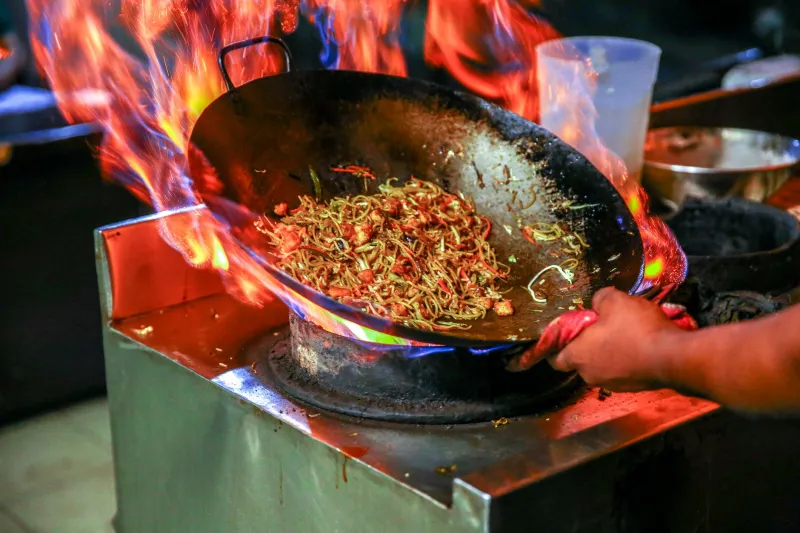
The lid reflex. When vegetables go into a pan or pot, the instinct is to cover them—trap the steam, speed up the cooking. But steam is exactly what softens vegetables past the point of no return. Shanghai stir-fries are done in an open wok over high heat, where moisture evaporates fast and the vegetable cooks through contact with the hot metal, not prolonged steaming.
Low heat comfort zones. Most American home cooks are nervous about high heat. They worry about burning, about smoke, about things happening too fast to control. But high heat is what gives you speed—and speed is what preserves texture. A vegetable cooked quickly over high heat has less time to lose water and collapse. Low, slow heat gives that water time to seep out, which is how you end up with a puddle in the pan and a limp vegetable on the plate.
The "just a little longer" instinct. This is the killer. You look at the pan, think it needs another minute, and give it one. That minute is usually the one that crosses the line. Shanghai cooks pull vegetables before they look done, trusting that residual heat will carry them the rest of the way.
Practical Moves That Actually Work
You don't need to rewire your entire approach to cooking. A few targeted adjustments will get you most of the way there.
Blanch fast, shock cold. For leafy greens and delicate vegetables, bring a big pot of heavily salted water to a rolling boil. Drop the vegetables in, wait for the color to pop—usually thirty seconds to two minutes depending on thickness—then immediately transfer them to an ice bath. This stops the cooking cold (literally) and locks in that bright color and snappy texture. It's the technique behind every perfectly cooked vegetable you've ever had at a good Chinese restaurant.
Dry your vegetables before they hit the pan. Wet vegetables steam instead of sear. Pat them down or spin them dry. This sounds fussy but it makes a real difference—especially for things like mushrooms, which will turn rubbery and gray if they go into a wet pan.
Prep in uniform cuts. Shanghai knife work is deliberate. Vegetables are cut to similar sizes so they cook evenly. One thick piece and three thin ones means someone's going to be raw and someone's going to be mush. Take the extra minute to make things consistent.
Add vegetables in stages. Denser vegetables—carrots, lotus root, thick-cut cabbage stems—go in first. Leafy greens and tender things go in last, sometimes just thirty seconds before you pull the whole dish off the heat. Staggering the cook time is how you get everything to land at the same moment of perfect doneness.
Trust your eyes and nose, not the clock. The color shift in green vegetables is your most reliable signal. Vivid, saturated green means you're at the window. Olive or army green means you've passed it. Your nose will also tell you—fresh, bright vegetable aroma is a good sign; a slightly sulfurous or flat smell means things have gone too far.
One Change, Wildly Different Results
The thing about this shift is that it doesn't just make vegetables taste better in isolation—it changes how the whole dish works. Crisp-tender vegetables hold their shape in a sauce instead of dissolving into it. They provide contrast against softer proteins or noodles. They make a plate look alive instead of slumped.
It's also, honestly, more forgiving once you get the instinct down. You're not trying to hit a precise internal temperature or time things to the minute. You're watching, smelling, tasting, and responding. That's how Shanghai home cooks operate—not from a recipe timer, but from a practiced sense of what the vegetable is telling you.
Start with something simple. Bok choy, broccolini, snap peas. Get your pan screaming hot, add a little oil, toss the vegetables in, keep them moving, and pull them when they look just barely done. Taste one. If it snaps back against your teeth and the flavor is bright and a little sweet, you've found the window.
That's cui. And once you know what it feels like, you'll never go back to mushy again.