The Smoke, the Sizzle, the Missing Piece: Why Wok Hei Lives in Steel, Not in a Basket
I like my air fryer. It reheats fried chicken better than anything I own, it handles a tray of eggplant without heating up the whole apartment, and it has never once set off my smoke alarm.
That last part is exactly the problem.
What wok hei actually is
Wok hei translates, roughly and a little romantically, as the breath of the wok. It is not a sauce, a seasoning, or a technique you can dial in on a keypad. It's a set of physical events happening in the same ninety seconds.
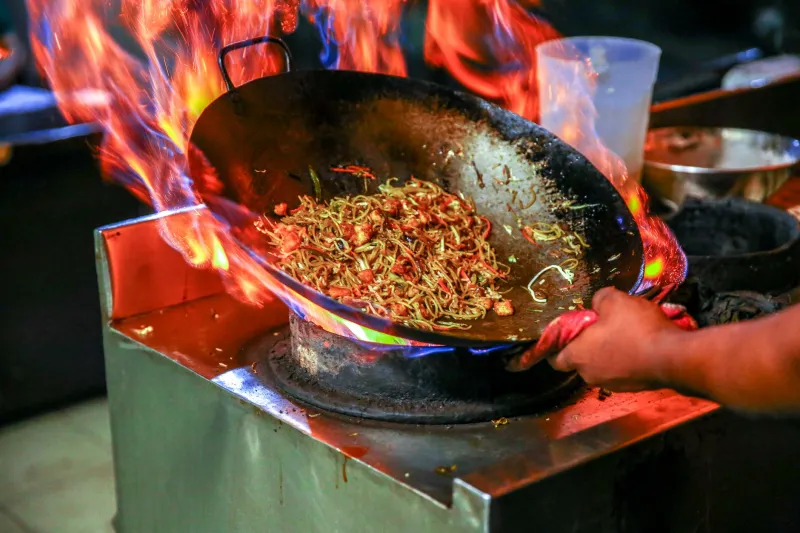
First, contact. Food hits carbon steel that is somewhere north of 600°F, sometimes much hotter, and the moisture on its surface flashes to steam. That steam, briefly, keeps the food from sticking while the surface beneath it starts browning hard — Maillard reactions and sugar caramelization running fast and hot.
Second, the aerosol. When you toss, tiny droplets of oil get flung into the air and into the flame path, where they ignite and burn off in a fraction of a second. Those micro-combustions deposit smoky, faintly bitter, deeply savory compounds back onto the food. That's the note people describe as char, or smoke, or simply the thing they cannot reproduce at home.
Third, motion. Constant tossing means nothing sits still long enough to steam in its own liquid. Ingredients pass through the hot zone and out again, over and over, so they sear instead of boil.
Take away any one of those and you get something else entirely. Something perfectly nice. Not wok hei.
Why convection can't fake combustion
An air fryer is a small oven with an aggressive fan. It moves a lot of hot air very fast, and it does that well. But hot air is a poor conductor compared to metal, and the maximum temperature is capped well below what a wok surface reaches. There's no flame licking the sides of a basket. There's no pool of superheated steel for food to smear against. There's no oil vapor igniting above the food because there's nothing to ignite it.
The result is browning that happens through the air — even, reliable, and shallow. You get crisp exteriors on things that are already dry and coated in oil. You do not get the blistered, slightly uneven, faintly acrid char that reads as wok cooking.
A home oven has the same limitation at a different scale. Even at 550°F, your food is being roasted, not seared. Roasting is a good thing to be. It just isn't wok hei.
Where the air fryer genuinely wins
I'm not here to bury the machine. Use it for what it does better than a wok:
- Reheating anything that used to be fried
- Drying out tofu or eggplant before it hits the wok
- First-pass cooking on chicken wings or potatoes, so the wok stage takes three minutes instead of twelve
- Crisping cured or braised meats that are already cooked through
Think of it as a prep cook that never complains.
The hybrid playbook
Here's how to get genuinely close in an American home kitchen.
Get the right pan for your stove. If you have gas, a round-bottom carbon steel wok and a wok ring. If you have electric or induction, a flat-bottom carbon steel wok — it will still take the heat, it just won't have flame crawling up the sides.
Preheat like you mean it. Five to eight minutes on high, dry, until a flick of water beads up and skates across the surface instead of sizzling away. If your wok isn't smoking lightly, it isn't ready.
Dry everything. Wet food is the number one reason home stir-fries steam. Pat proteins, drain greens in a salad spinner, and don't crowd. Two cups of food maximum per batch. Three batches beats one soggy one, every single time.
Then cheat, deliberately. After the wok toss, spread the food on a sheet pan and run it under the broiler for sixty to ninety seconds. The wok does the flavor work; the broiler does the blistered edges. For meats, a kitchen torch passed quickly over the finished platter adds a very convincing char without cooking anything further.
Go outside if you can. A turkey fryer burner, a portable high-output butane rig, or a wok set directly on hot grill grates will get you closer to restaurant heat than anything indoors. Twenty minutes on the patio is worth it.
Build smoke on purpose. Toasted Sichuan peppercorn, a pinch of smoked salt, or a teaspoon of very hot oil poured over aromatics at the end can imply a char that your burner couldn't deliver.
The honest version
Restaurant wok hei comes from burners pushing six figures of BTU and a cook who has done the same motion ten thousand times. Your kitchen is not that, and it doesn't have to be. The goal isn't authenticity-by-brochure. It's a plate with real browning, real smoke, and vegetables that crunch.
Use the air fryer for what it is. Save the wok for what only it can do.