The Alleys Have All the Answers: Why Shanghai's Greatest Food Was Never on a White Tablecloth
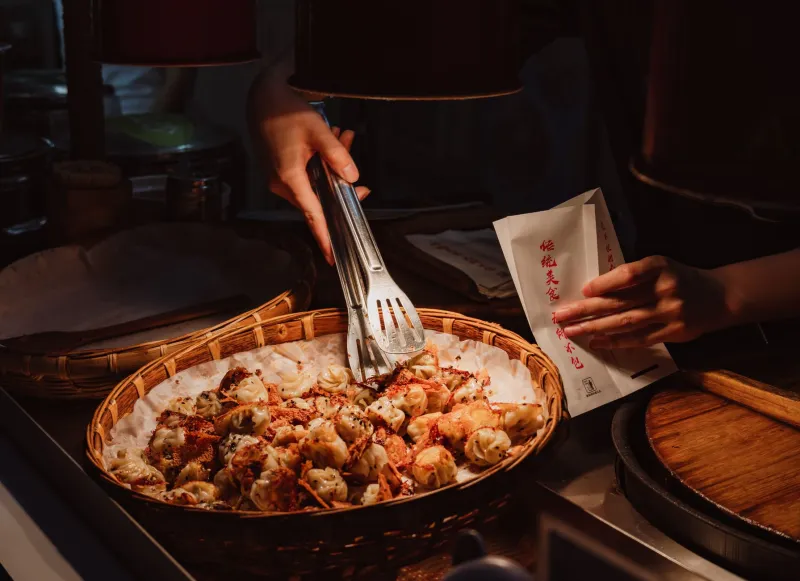
Let me tell you about a meal I'll never forget. It wasn't at a restaurant with a reservation waitlist or a chef with a James Beard nomination. It was standing on a sidewalk in Flushing, Queens, holding a paper bag that was already going translucent with grease, eating a sheng jian bao—pan-fried pork buns—so good that I genuinely had to stop walking.
The woman who made them had learned from her mother in Shanghai. Her mother had learned from her mother, who sold them from a cart in the Huangpu district before the city became what it is today. Three generations of knowledge, passed hand to hand, now living in a commercial kitchen in Queens that I wouldn't have found without a tip from someone's cousin.
That's Shanghai food. Not the lacquered dining rooms with $30 dumplings and a QR code menu. The real stuff lives in the alleys, in the home kitchens, in the food that people make because they grew up eating it and can't imagine eating anything else.
A City Built on Humble Beginnings
Shanghai's food identity is complicated by its history. The city has always been a place of collision—a port town that absorbed influences from across China and eventually the world. Cantonese migrants brought their techniques. Ningbo fishermen brought their seafood traditions. Suzhou's sweeter sensibility crept into the sauces. Out of that beautiful chaos came something distinctly Shanghainese.
But here's what often gets lost in the glossy food media narrative: almost none of Shanghai's most beloved dishes were invented in fancy restaurants. Xiaolongbao—those iconic soup dumplings that every food traveler puts on their Shanghai bucket list—originated in Nanxiang, a suburb of Shanghai, sometime in the mid-1800s. They were street food, sold from small shops to working people who wanted something hot and filling. The thin skin, the collapsing broth, the careful crimp—these were the innovations of modest cooks trying to feed a crowd, not chefs trying to impress critics.
Jianbing, the savory breakfast crepe that's become a cult item at food stalls across the US, has roots in northern China but became a Shanghai morning staple through the hands of street vendors who set up before sunrise and packed up by 9 a.m. You ate it walking. You ate it fast. That was the point.
Even something as seemingly sophisticated as hong shao rou—the meltingly tender red-braised pork belly that's probably Shanghai's most famous dish—is fundamentally home cooking. It's a recipe built around cheap, fatty cuts of pork slow-cooked in soy sauce, rice wine, and sugar until they become something transcendent. It tastes expensive because the technique is good, not because the ingredients are rare.
What Gets Lost When Dishes Move Upmarket
Here's my honest opinion: something changes when street food gets dressed up for fine dining, and it's not always a change for the better.
I've had xiaolongbao at high-end Shanghainese restaurants in New York and San Francisco, and they're often technically impressive—the skins are uniform, the broth is clear and refined, the presentation is immaculate. But they're also somehow... quieter. The flavors are more restrained. The richness that makes a great soup dumpling feel like a small miracle gets softened in the translation to a format that needs to appeal to people who are paying $28 for a bamboo steamer.
Mei Lin, a home cook in the San Gabriel Valley who emigrated from Shanghai fifteen years ago, puts it this way: "My xiaolongbao are not pretty. The folds are not even. But the filling is my grandmother's filling, and the skin is thin enough that it breaks when you pick it up wrong, which is how it should be. Restaurant xiaolongbao are engineered to survive the trip from kitchen to table. Mine are engineered to be eaten immediately, standing up, burning your mouth a little."
There's a philosophy in that description. Street food and home cooking operate under different constraints than restaurant food, and those constraints are often what create the best flavors. You're not managing food cost percentages or worrying about how a dish photographs. You're just trying to make something that tastes right.
The Immigrant Kitchen as Living Archive
The most important custodians of authentic Shanghai flavors in America aren't restaurant chefs. They're home cooks—people like Mei Lin, like the woman in Flushing with her sheng jian bao, like the countless families across the country who make a specific dish for the Lunar New Year because that's what their family has always made.
These cooks are keeping alive recipes that never got written down, techniques that exist only in muscle memory, flavor profiles that would disappear entirely if the chain of transmission broke. And that chain is more fragile than it looks.
Jenny Zhao, who grew up in Shanghai and now lives in the Chicago suburbs, has been spending the last few years documenting her mother's recipes before they're lost. "My mother doesn't measure anything," she says. "She adds soy sauce until it looks right. She knows when the oil is hot enough by how it moves in the pan. How do you write that down? How do you teach someone who didn't grow up watching it?"
Jenny's project—a hand-written notebook and a series of videos she makes for her own family—is a microcosm of what's happening in Chinese-American communities across the country. The first generation carries the knowledge. The second generation is realizing, often urgently, that they need to capture it before it's gone.
Bringing the Alley Home: A Few Places to Start
If you want to connect with authentic Shanghai flavors in your own kitchen, forget the restaurant reproductions for a minute. Here's where to actually begin.
Start with a market run, not a recipe. Head to your nearest Asian grocery store—99 Ranch, H Mart, or a local independent—and look for the ingredients that define Shanghai cooking: Shaoxing rice wine, dark soy sauce, rock sugar, and fresh ginger. These are the building blocks. Once they're in your pantry, a huge range of dishes becomes accessible.
Make hong shao rou on a Sunday. Red-braised pork belly is forgiving, deeply satisfying, and will make your kitchen smell incredible for hours. It's the kind of dish that teaches you the Shanghainese approach to flavor—the balance of sweet, savory, and umami—better than any amount of reading.
Find a jianbing kit or make your own. Jianbing batter is essentially a thin mung bean and wheat flour crepe. The toppings—hoisin sauce, chili paste, scallions, a crispy wonton cracker—are what make it sing. It's a weekend breakfast project that will ruin you for ordinary eggs.
Seek out immigrant-owned vendors and pop-ups. In most major American cities, there are home cooks selling food at farmers markets, through Instagram, or at community events. These are your best access points to the real thing. Support them. Ask them questions. They're doing something irreplaceable.
The Bottom Line
Shanghai's food culture is not a museum piece. It's alive, it's traveling, and right now, a lot of it is living in home kitchens across the United States, in the hands of people who learned to cook from someone who learned to cook from someone who stood in an alley and fed strangers for a living.
At Shanghai Shiok, that's the tradition we're here to celebrate. Not the polished, exported version of Chinese cuisine—the real one, with uneven folds and broth that burns your chin and flavors that don't apologize for themselves.
The white tablecloth has its place. But the alley? The alley is where the soul lives.